
In my previous post, I discussed how better prompts often lead to better AI outcomes. But even the best prompt has a limitation. What if the AI needs access to information that was never part of its training?
Consider a banking scenario. A customer asks: "Am I eligible for a ₹50 lakh home loan?" At first glance, this appears to be a simple question. Answering it accurately, however, requires two things:
- Knowledge of the bank's current lending policies
- Access to the customer's financial information
This is where two concepts become interesting: RAG (Retrieval-Augmented Generation) and MCP (Model Context Protocol).
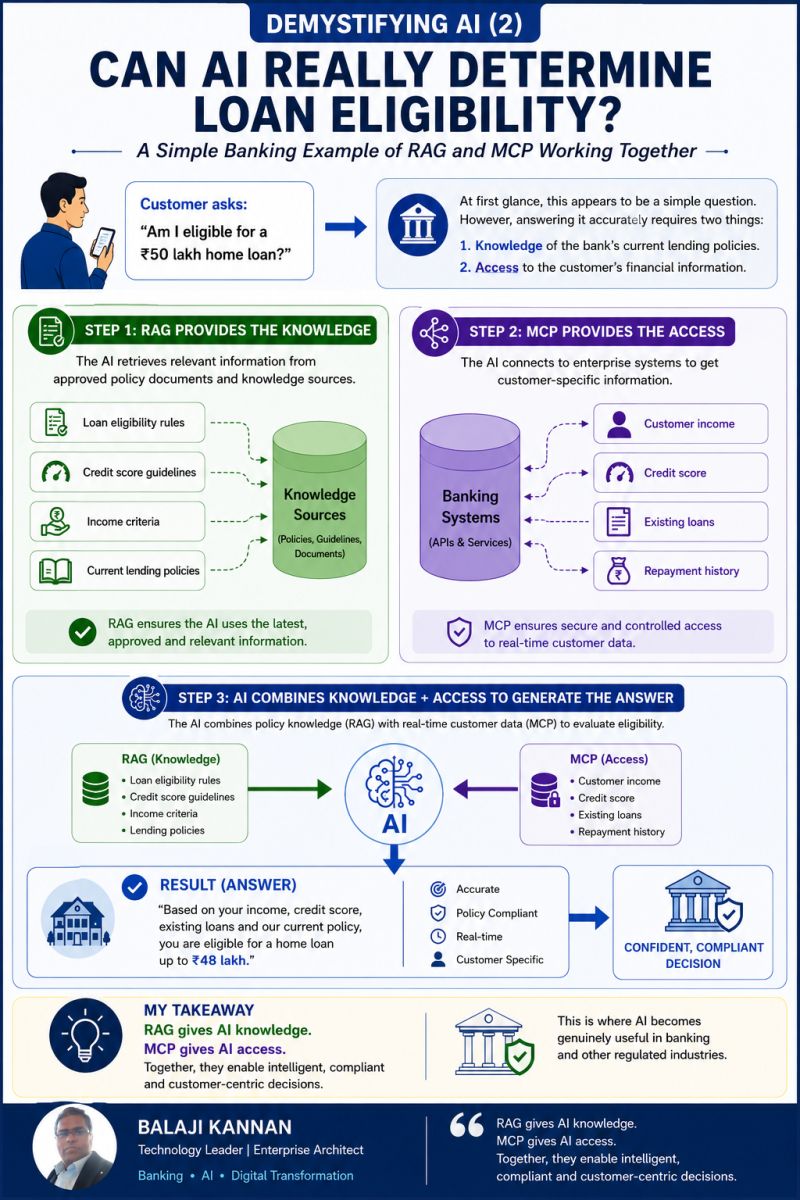
Step 1: RAG provides the knowledge
The AI retrieves relevant information such as:
- Loan eligibility rules
- Credit score guidelines
- Income criteria
- Current lending policies
Rather than relying solely on what it learned during training, the AI can draw on the latest approved information.
Step 2: MCP provides access
The AI may need access to enterprise systems to obtain customer-specific information, for example:
GetCustomerIncome()GetCreditScore()GetExistingLoans()
These aren't answers found in documents. They're obtained from enterprise systems and services.
Putting it together
The customer asks: "Am I eligible for a ₹50 lakh home loan?" RAG helps the AI understand what the current eligibility rules are. MCP helps the AI determine what's true for this specific customer. Together, the AI can provide a more accurate, context-aware response.
As with any banking use case, actual implementations would need to operate within appropriate security, privacy, governance, and regulatory frameworks. This example is intended to illustrate the roles of RAG and MCP in an enterprise context, not to prescribe a production implementation.
For banking and other regulated industries, this is where AI starts becoming genuinely useful. What enterprise use cases do you think could benefit most from combining RAG and MCP?